WALEED.
SECTION 02/ Production Case Studies

Engineered Systems & Technical Architectures

An asymmetric editorial archive of full-stack web platforms, AI evaluation engines, and database-driven applications by Muhammad Waleed (Waleed KN).

FILTER //
NO. 01/ AI / ML
2026Independent Engineering Project
PLATE 01RAG Document Q&A — AI Assistant with Cited Answers
[ SYSTEM PREVIEW // 01 ]PRODUCTION BUILD
PGVECTOR INDEXGEMINI EMBED
CHUNK #14 (P. 04)0.89 SIM
CHUNK #22 (P. 09)0.84 SIM
THRESHOLD GUARDACTIVE
CITED SYNTHESIS // GROQCI + 30+ TESTS

Verified answer synthesized from uploaded PDF context with strict page-level source attribution and automatic model fallback.

[CITATION: PAGE 04][CITATION: PAGE 09]
VERIFIED ARCHITECTUREWALEED // 01

RAG Document Q&A — AI Assistant with Cited Answers

Page-level cited document Q&A with semantic search, similarity thresholding, and $0 infrastructure cost.

Built and deployed a document Q&A app that returns page-level cited answers and declines out-of-scope questions through semantic search with a similarity threshold, using pgvector, Gemini embeddings, and Groq at $0 infrastructure cost.

PROBLEM ADDRESSED

Standard LLM chat interfaces hallucinate answers when queried against private PDFs and fail to tell users which exact page a claim came from or when a question falls outside the uploaded documents.

TARGET USERS

Training teams, researchers, analysts, and internal operations staff who need verifiable, page-cited answers from technical manuals and PDFs.

SOLUTION ARCHITECTURE

Next.js Route Handlers ingest PDFs into page-tagged text chunks, generate vector embeddings via Gemini, store vectors in Neon PostgreSQL (pgvector), and retrieve top-k chunks above a cosine similarity threshold before synthesizing cited responses via Groq.

  • —Built and deployed a document Q&A app that returns page-level cited answers and declines out-of-scope questions, through semantic search with a similarity threshold, using pgvector, Gemini embeddings, and Groq at $0 infrastructure cost
  • —Kept the app reliable within free-tier API limits through resumable batch embedding, automatic model fallback, and Postgres-backed rate limiting (3 questions per minute per visitor), using Next.js route handlers and Neon
  • —Shipped with 30+ unit tests, an evaluation harness that scores answer correctness, citation accuracy, and refusals, and CI on GitHub Actions (lint, type-check, tests, build, Docker image)
Next.jsTypeScriptPostgreSQL (pgvector)GeminiGroqDockerGitHub Actions
NO. 02/ AI / ML
2026Independent Engineering Project
PLATE 02MCQForge — Automated Document-to-MCQ Assessment Platform
[ SYSTEM PREVIEW // 02 ]PRODUCTION BUILD
PDF.JS + MAMMOTH + OCR
Multi-Column MCQ & Key Extractor
CONFIDENCE + DEDUP
UPSTASH REDIS LUA113+ VITEST + E2E
Session-Isolated Review & Timed Exam Engine
STRICT ZOD SCHEMA VALIDATION
VERIFIED ARCHITECTUREWALEED // 02

MCQForge — Automated Document-to-MCQ Assessment Platform

Full-stack assessment platform extracting MCQs and answer keys from multi-column PDF, DOCX, and TXT study documents.

Engineered a full-stack assessment platform that extracts multiple-choice questions and answer keys from multi-column PDF, DOCX, and TXT study documents with OCR fallback, confidence scoring, and duplicate detection. Built session-isolated question review and timed/untimed exam workflows backed by Upstash Redis atomic Lua scripts, strict Zod schema validation, 113+ Vitest unit tests, and Playwright E2E tests.

PROBLEM ADDRESSED

Training providers and educators spend hours manually retyping multiple-choice questions and answer keys out of multi-column PDFs, scanned handouts, and DOCX banks into online quiz tools.

TARGET USERS

Certification academies, training companies, instructors, and students preparing structured practice exams from existing study documents.

SOLUTION ARCHITECTURE

Next.js App Router frontend with PDF.js and Mammoth document parsers plus OCR fallback, feeding a structured extraction pipeline with confidence scoring and duplicate detection, backed by Upstash Redis atomic Lua scripts for session-isolated review and exam state.

  • —Engineered a full-stack assessment platform that extracts multiple-choice questions and answer keys from multi-column PDF, DOCX, and TXT study documents with OCR fallback, confidence scoring, and duplicate detection
  • —Built session-isolated question review and timed/untimed exam workflows backed by Upstash Redis atomic Lua scripts, strict Zod schema validation, 113+ Vitest unit tests, and Playwright E2E tests
Next.jsTypeScriptUpstash Redis (Lua)PDF.jsMammothZodVitestPlaywright
NO. 03/ Full-Stack
2026Independent Engineering Project
PLATE 03RideShare — Real-Time Ride-Hailing Platform
[ SYSTEM PREVIEW // 03 ]PRODUCTION BUILD
REDIS GEOSPATIAL + WEBSOCKETLIVE STATE MACHINE
REQUESTED→ACCEPTED→IN PROGRESS→PAID
VERIFIED ARCHITECTUREWALEED // 03

RideShare — Real-Time Ride-Hailing Platform

Real-time rider-driver matching via Redis geospatial index, WebSockets, and a 5-state ride lifecycle.

Built real-time rider-driver matching through a Redis geospatial index and WebSocket live location and ride-status updates in a full-stack Next.js platform with a server-validated 5-state ride lifecycle.

PROBLEM ADDRESSED

On-demand dispatch platforms require low-latency proximity matching, synchronized live location updates, and strict server-side state transitions so rides cannot be double-booked or skipped out of order.

TARGET USERS

Mobility startups and logistics teams evaluating real-time geospatial dispatch and live WebSocket state synchronization.

SOLUTION ARCHITECTURE

Next.js full-stack application integrating a Redis geospatial index (GEOADD/GEORADIUS) for nearby driver discovery, WebSocket channels for live coordinate and status broadcasts, Mapbox for geocoding/routing, and Stripe (test mode) for checkout.

  • —Built real-time rider-driver matching through a Redis geospatial index and WebSocket live location and ride-status updates in a full-stack Next.js platform
  • —Designed a server-validated 5-state ride lifecycle (requested → accepted → in progress → completed → paid) using Mapbox for geocoding/routing and Stripe test-mode payments
Next.jsWebSocketRedis (geospatial)MapboxStripe (test mode)JWT
NO. 04/ AI / ML
2026Portfolio Demonstration
PLATE 04AI Cold Email Automation (n8n)
[ SYSTEM PREVIEW // 04 ]PRODUCTION BUILD
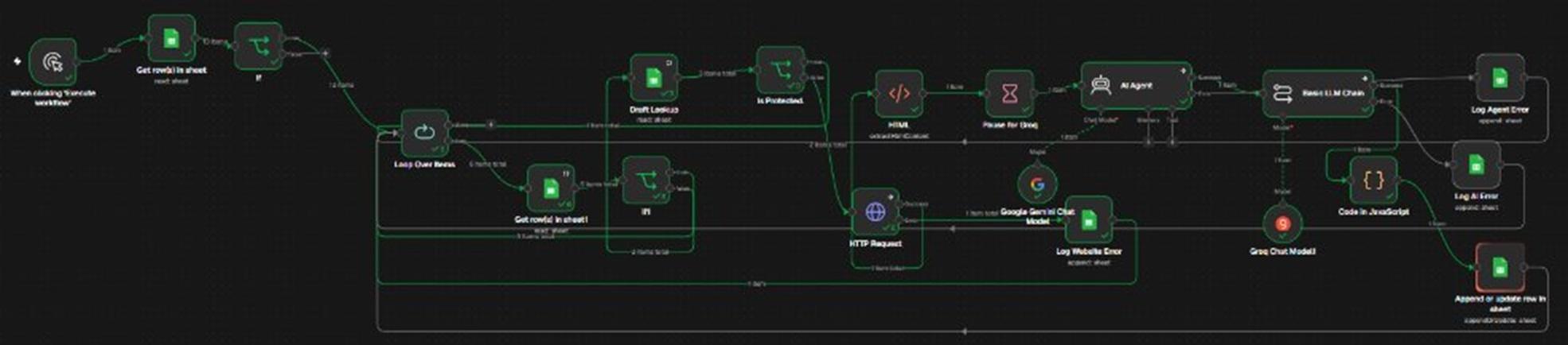
AI Cold Email Automation n8n workflow: Google Sheets leads, Groq research, AI agent drafting and quality check
VERIFIED ARCHITECTUREWALEED // 04

AI Cold Email Automation (n8n)

Two human-in-the-loop n8n workflows that research company websites with Groq, draft quality-checked cold emails, and dispatch approved sends.

Two n8n workflows that draft and send personalised cold emails with a human in the loop. The drafting workflow reads leads from Google Sheets, skips invalid and duplicate leads, researches each company's website with an AI model (Groq), writes a short email, and runs a rule-based quality check. Drafts are saved for manual review. The sending workflow sends only approved drafts, after checking an unsubscribe list, a pause switch and a daily limit, then logs every send.

PROBLEM ADDRESSED

Automated outbound tools often send generic or hallucinated AI emails without human oversight, fail on broken prospect URLs, or risk spamming unsubscribed contacts.

TARGET USERS

B2B agencies, SaaS founders, and business development teams that want AI-assisted personalization with strict human approval before sending.

SOLUTION ARCHITECTURE

Two decoupled n8n workflows backed by Google Sheets as the operational ledger: Workflow 1 fetches leads, scrapes/researches company websites, drafts via Groq (openai/gpt-oss-20b), and runs a JavaScript quality gate; Workflow 2 checks approval status, unsubscribe list, global pause switch, and daily send caps before dispatching via Gmail.

  • —Human approval before any email is sent
  • —Duplicate and unsubscribe protection
  • —Fail-safe pause switch
  • —Quality checker for greeting, length, banned words and invented facts
  • —Bad websites are skipped without stopping the run
n8nGroq (openai/gpt-oss-20b)Google SheetsGmailJavaScript
NO. 05/ AI / ML
2026Independent Engineering Project
PLATE 05CodeScout — AI Codebase Intelligence & RAG
[ SYSTEM PREVIEW // 05 ]PRODUCTION BUILD
SYSTEM ARCHITECTURE // AI / ML
CodeScout — AI Codebase Intelligence & RAG
VERIFIED ARCHITECTUREWALEED // 05

CodeScout — AI Codebase Intelligence & RAG

Index any public GitHub repository into Neon pgvector and ask plain-English questions backed by exact file and line-range citations.

Built and deployed a Retrieval-Augmented Generation (RAG) web application for developers that streams public GitHub repository tarballs, chunks source files into 40-line overlapping windows with 1-based line numbers, indexes 768-D embeddings in Neon pgvector, and answers questions strictly from retrieved code with exact file:startLine-endLine citations.

PROBLEM ADDRESSED

Developers onboarding onto unfamiliar open-source repositories or auditing team codebases waste hours manually grepping through folders to trace entry points, APIs, and data flows.

TARGET USERS

Software engineers, technical leads, and contributors who need fast, verifiable answers about unfamiliar GitHub repositories without reading every file manually.

SOLUTION ARCHITECTURE

Next.js and TypeScript RAG application that streams public GitHub repository tarballs in memory (skipping node_modules, lockfiles, images, and binaries), splits source files into 40-line overlapping windows with 1-based line numbers, stores 768-D embeddings in Neon PostgreSQL (pgvector), and retrieves top chunks by cosine similarity for grounded, line-cited answers.

  • —Streaming in-memory GitHub tarball ingestion skipping lockfiles, binaries, and node_modules
  • —40-line overlapping vector chunks with 1-based line numbers in Neon pgvector (768-D)
  • —Zero-hallucination answers with clickable path:start-end citations and strict refusal guardrails
Next.jsTypeScriptNeon (pgvector)RAGGitHub API
NO. 06/ Full-Stack
2026Portfolio Demonstration
PLATE 06E-Commerce Platform
[ SYSTEM PREVIEW // 06 ]PRODUCTION BUILD
SYSTEM ARCHITECTURE // Full-Stack
E-Commerce Platform
VERIFIED ARCHITECTUREWALEED // 06

E-Commerce Platform

Full-stack e-commerce platform with authentication, role-based access, cart, and order management.

Built a full-stack e-commerce platform with authentication, role-based access, cart, and order management, secured with JWT sessions, bcrypt hashing, and a protected admin dashboard using Prisma ORM.

PROBLEM ADDRESSED

Retail businesses need a unified storefront and protected administrative backend with role-based access control and reliable relational order persistence.

TARGET USERS

Online retail businesses and teams needing custom storefront + admin order management.

SOLUTION ARCHITECTURE

Next.js full-stack application with Auth.js, JWT sessions, bcrypt password hashing, PostgreSQL, and Prisma ORM powering customer storefronts and role-gated admin dashboards.

  • —Built a full-stack e-commerce platform with authentication, role-based access, cart, and order management
  • —Secured it with JWT sessions, bcrypt hashing, and a protected admin dashboard, using Prisma ORM for data management
Next.jsPostgreSQLAuth.jsPrisma
NO. 07/ Full-Stack
2026Portfolio Demonstration
PLATE 07POS System
[ SYSTEM PREVIEW // 07 ]PRODUCTION BUILD
SYSTEM ARCHITECTURE // Full-Stack
POS System
VERIFIED ARCHITECTUREWALEED // 07

POS System

Point-of-sale web system for retail transactions and inventory tracking.

A Next.js point-of-sale application using PostgreSQL and Prisma ORM to manage commercial transactions, product stock, and operational billing workflows.

PROBLEM ADDRESSED

Small retail operations need fast checkout billing tied directly to real-time inventory counts in a relational database.

TARGET USERS

Retail operators and small commercial businesses managing daily sales and stock.

SOLUTION ARCHITECTURE

Next.js web interface backed by PostgreSQL and Prisma ORM for atomic transaction recording and stock updates.

  • —Transaction-focused checkout and receipt workflow
  • —Relational inventory and sales persistence with PostgreSQL and Prisma
  • —Built for commercial retail operations
Next.jsPostgreSQLPrisma
NO. 08/ Web Applications
2025Portfolio Demonstration
PLATE 08Movie Search App
[ SYSTEM PREVIEW // 08 ]PRODUCTION BUILD
SYSTEM ARCHITECTURE // Web Applications
Movie Search App
VERIFIED ARCHITECTUREWALEED // 08

Movie Search App

Media discovery application integrated with the TMDB REST API.

A responsive movie discovery application leveraging Next.js and the TMDB API to search titles, inspect ratings, and browse catalog metadata.

PROBLEM ADDRESSED

Users browsing large media catalogs need responsive search, filtering, and clean metadata presentation without page clutter.

TARGET USERS

General media consumers and frontend architecture demonstrations.

SOLUTION ARCHITECTURE

Next.js application querying the TMDB REST API with responsive grid rendering and detail views.

  • —Real-time movie search and filtering via TMDB API
  • —Fast client and server rendering patterns in Next.js
  • —Responsive media catalog layout
Next.jsTMDB API
NO. 09/ Web Applications
2025Portfolio Demonstration
PLATE 09Recipe Finder
[ SYSTEM PREVIEW // 09 ]PRODUCTION BUILD
SYSTEM ARCHITECTURE // Web Applications
Recipe Finder
VERIFIED ARCHITECTUREWALEED // 09

Recipe Finder

Ingredient and dish search platform powered by the Spoonacular API.

A recipe discovery application built with Next.js and TypeScript that queries the Spoonacular API to surface cooking instructions and nutritional breakdowns.

PROBLEM ADDRESSED

Finding recipes based on available ingredients requires structured filtering and clear step-by-step instructions.

TARGET USERS

Home cooks and users exploring ingredient-based search.

SOLUTION ARCHITECTURE

Next.js and TypeScript frontend consuming the Spoonacular REST API with typed data models.

  • —External REST API integration with typed response handling
  • —Ingredient-based search and detailed recipe views
Next.jsTypeScriptSpoonacular API
NO. 10/ Web Applications
2025Portfolio Demonstration
PLATE 10GitHub Profile Finder
[ SYSTEM PREVIEW // 10 ]PRODUCTION BUILD
SYSTEM ARCHITECTURE // Web Applications
GitHub Profile Finder
VERIFIED ARCHITECTUREWALEED // 10

GitHub Profile Finder

Developer profile and repository explorer built on the GitHub REST API.

A developer search utility built with Next.js and the GitHub API to inspect public engineering profiles, repository metrics, and contribution activity.

PROBLEM ADDRESSED

Quickly inspecting a developer profile, top repositories, and language distribution across GitHub pages.

TARGET USERS

Developers and technical recruiters reviewing public GitHub profiles.

SOLUTION ARCHITECTURE

Next.js client/server integration querying the public GitHub REST API for user and repository endpoints.

  • —Live querying of public GitHub user profiles and repositories
  • —Clean presentation of repository stars, languages, and profile metadata
Next.jsGitHub API